

Short answer: Caregivers cannot control a diagnosis, the speed of decline, a parent’s personality, or whether other family members help. What you can control is your own response, your preparation, your boundaries, and where you put your energy. Stoic philosophy teaches that peace comes from sorting these two categories clearly and then refusing to spend yourself on the first one.
It is 3:14 in the morning and you are running the list again.
The MRI results. Whether the new medication is going to work. Whether your brother is ever going to return a phone call. Whether you should have caught the signs earlier, six months ago, when she kept saying she was just tired.
You are not solving anything at 3:14 in the morning. You know that. But your mind has decided that worrying about these things is the same as doing something about them, and it will not let you go back to sleep until you have worried about all of them at least twice.
What can a family caregiver actually control?
Almost two thousand years ago, a Roman emperor was writing notes to himself about this exact problem. He was managing a war, a plague, and a body that was failing him. In the private journal we now call Meditations, Marcus Aurelius wrote:
“You have power over your mind, not outside events. Realize this, and you will find strength.”
He was not writing a self-help book. He was reminding himself, over and over, because he kept forgetting. That detail matters. Even the man who wrote the sentence had to keep relearning it.
Why this hits differently when you are a caregiver
Most advice about letting go of control is aimed at people who are being a little controlling. That is not what is happening to you.
You are in a role where the stakes are genuinely high and where paying close attention has genuinely prevented bad outcomes. You caught the UTI because you noticed she was confused in a new way. You caught the medication error because you read the label. Your vigilance has been rewarded, over and over, and so your brain has drawn a reasonable conclusion: if I watch everything closely enough, I can prevent the bad thing.
That belief is what keeps you awake. Because it means every bad thing that happens is, somewhere in the back of your mind, a thing you failed to prevent.
The Stoics would tell you that you are carrying two very different kinds of weight and treating them the same. One kind is real work: managing the medications, learning the disease, making the house safer, asking better questions at appointments. That weight is yours and it is worth carrying.
The other kind is not work at all. It is rehearsal. Replaying the appointment. Imagining the fall that has not happened. Composing the speech you will never give your brother. None of it changes anything, and all of it costs you the energy you need for the first kind.
The line between them is the whole lesson. What is mine, and what was never mine.

One thing you can do today
Get a piece of paper and draw a line down the middle.
On the left, write every single thing weighing on you right now. Do not filter it. The MRI. Your brother. The bathroom that is not safe yet. The way she looked at you yesterday. Whether you are doing this right. Whatever comes.
Now go through the list one item at a time and ask one question: is there an action I could take on this in the next seven days?
If yes, move it to the right column and write the action next to it. Not the goal, the action. Not “make the bathroom safe,” but “measure the doorway and call about grab bar installation.”
If no, leave it on the left.
The left column is not a to-do list. It is a list of things you have been carrying that will not move no matter how hard you carry them. You are not going to stop caring about them. But you can stop treating them as tasks you are failing at.
Some caregivers find it helps to keep the paper. When the 3 a.m. list starts up, they get up, look at the page, and confirm that the thing keeping them awake is already in the left column. It has already been examined. It is not new information.
The right column is your actual life. That is where your energy belongs.
Sit with this
Which item on your left column have you been treating as your fault?
Going deeper with this lesson
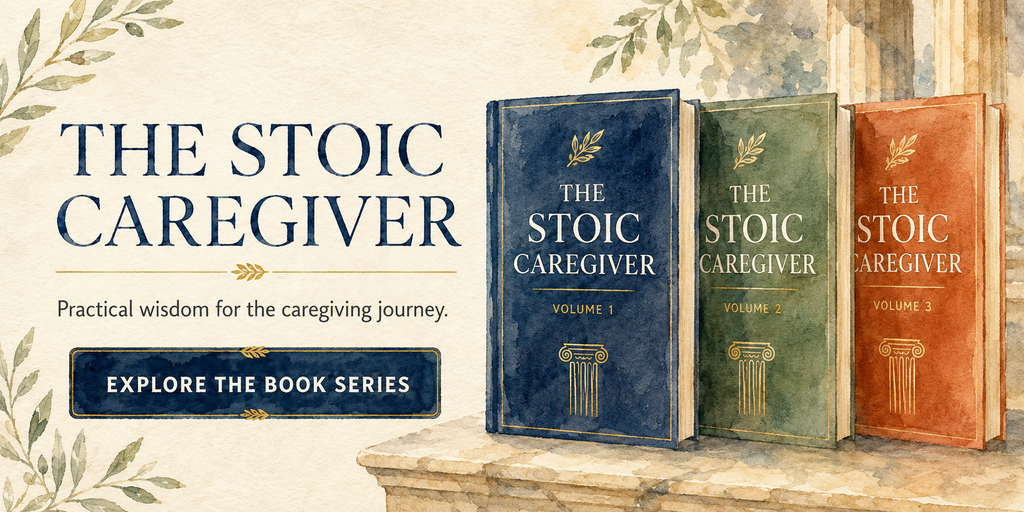
This is Lesson 1 of the 60 lessons in The Stoic Caregiver series.
The full version of this lesson in Volume 1 includes three more practical exercises, a longer reflection written specifically for caregivers who are early in the role, a journaling prompt, and a worksheet page you can write on or print out.
Volume 1 covers Lessons 1 through 20, the foundation: what you can and cannot control, working with the resources you actually have, radical acceptance, quieting catastrophic thinking, and finding the part of your identity that exists underneath the caregiver role.
Get Volume 1 | Get the Complete 3-Volume Series