Short answer: No, it is not wrong to want your old life back. Your life got smaller without a vote from you. What costs you is not the wanting itself but the wanting aimed at things that were never going to arrive, which runs in the background all day and bills you whether you look at it or not.
You were looking for the supplemental insurance card and you found your passport instead, at the back of the drawer, expired since 2023. You stood there holding it a second longer than you meant to.
Then you put it back, found the card, and went to the kitchen because the microwave was beeping. It was the middle of a Tuesday. Nothing happened.
Is it wrong to want your old life back while caregiving?
Epictetus owned almost nothing his whole life, first because he was born a slave and later because he had no use for more, teaching out of a small house with a lamp, a rush mat, and not much else.
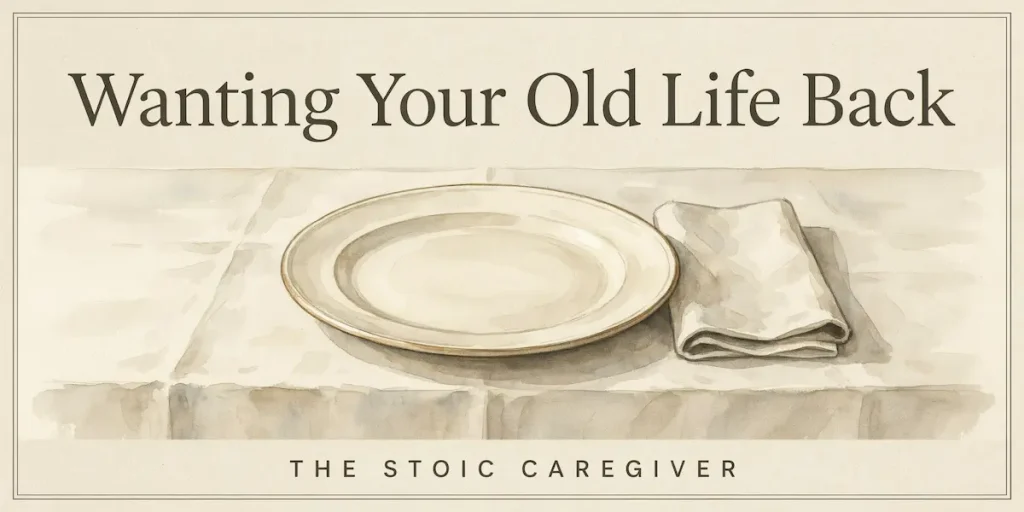
“Remember that you must behave in life as at a banquet. Is anything brought round to you? Put out your hand and take your share with moderation. Does it pass by you? Do not stop it. Is it not yet come? Do not stretch your desire towards it, but wait till it is opposite to you.”
Why this hits differently when you are a caregiver
Epictetus is not telling you to skip dinner. The banquet is a good one and he expects you to eat. What he is naming is the reaching. The dish that already went past. The one that has not come around yet. The way a person can spend a whole meal leaning after both while the food on their own plate goes cold.
Most advice about wanting less assumes you chose less. Your life got smaller without anybody asking, and being told to be content with what is left is the kind of thing people say who have not done a week of it.
So the useful question is not how to want less. It is which of your wants is still doing something for you.
Some are. Wanting her comfortable. Wanting to do this well enough that you can live with it afterward. Wanting one honest conversation with your brother about money. Those are worth what they take out of you.
Others have been running for years and have never once delivered. Wanting her to be the way she was in 2019. Wanting your sister to turn into a person who calls on Sundays.
Wanting somebody, anybody, to say out loud that this is hard and you are doing it well. Those run all day whether you think about them or not, and each one takes something.
That is what the old line about wealth being few wants is actually pointing at. It was never about owning less. It is that a person carrying fewer open demands on reality has more of herself left at six in the evening.
And here is the part nobody says. Some of these you will keep even though they hurt and will never be filled. Wanting her back is one of those. You do not have to give that up, and anyone who tells you to is wrong.
You only have to know which ones you are paying for, because right now the money is coming out of an account you never check.

One thing you can do today
Take a piece of paper and write “I am waiting for” at the top. Then finish that sentence as many times as you can in five minutes. Do not tidy them up as you go.
They will come out plainer than you expect. I am waiting for her to say thank you. I am waiting for a Saturday with nothing in it. I am waiting for someone to tell me I am doing this right.
Now mark each one. Could happen, or will not happen. Be strict. Not “might someday,” which is how these stay alive for fifteen years. You already know which is which, and nobody else is reading it.
Then take the single one you have been waiting on longest with the least to show for it, and say it out loud once, in the past tense. “He was never going to call first.”
That is not giving up on him. It is setting down something you have been holding out at arm’s length for years, and your arm is tired.
When it gets hard: you will want to add “but he could.” That is the reaching. Let the sentence stand without the rescue clause. You may also find something on the list you did not know was there. Leave it. Keep the paper somewhere you will find it again in six months.
Sit with this
What have you been waiting for so long that you stopped noticing you were waiting?
Going deeper with this lesson
The exercise above is one of four in Lesson 18. The book covers the rest: how to tell a want that still serves you from one that only bleeds, what to do about the version of your life you had planned for these years, and how to take the good that does come around without flinching at it.
There is a full written reflection and a worksheet page for the waiting inventory. Lesson 18 sits in Volume 1, the first twenty lessons, which cover control, acceptance, and the ground under your feet before the harder family questions in Volume 2.