
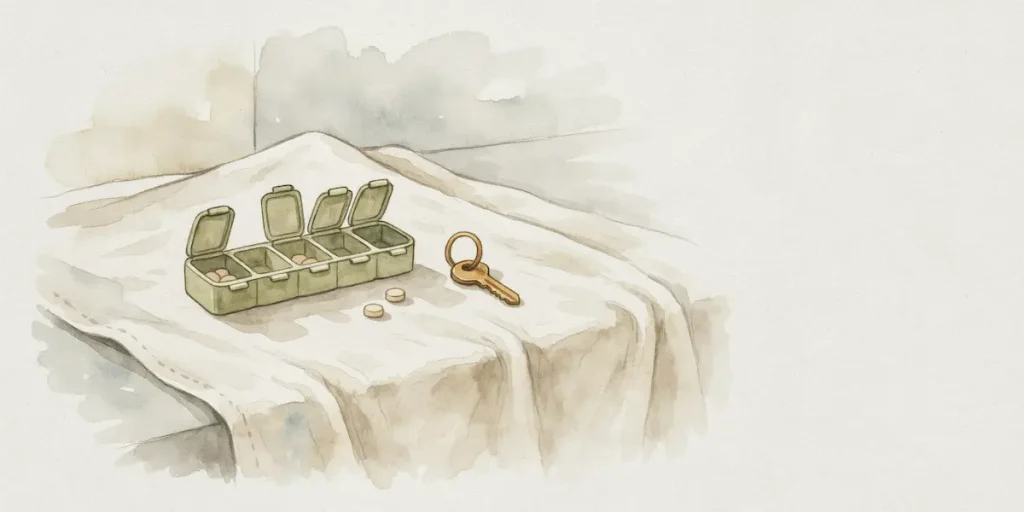
Short answer: Feeling trapped as a caregiver is a normal response to a situation that really does limit your time, money, and choices. You cope by separating what is fixed right now from what is still yours to decide, such as your attention, your tone, and small choices inside the day. Naming both clearly makes the walls smaller and helps you spot which ones can move.
You are sitting in the pharmacy parking lot with the engine running and the prescription bag on the passenger seat. Your sister’s photos from the lake just popped up on your phone. You do the math. Dad wakes from his nap in twenty-two minutes, and the drive home takes twelve. You don’t put the car in reverse yet. You just sit there with your hands on the wheel.
How do I cope with feeling trapped as a caregiver?
Epictetus was born into slavery in the first century and walked with a disabled leg for most of his life. His student Arrian later collected his teaching into a short handbook, which includes this line:
“Disease is an impediment to the body, but not to the will, unless the will itself chooses. Lameness is an impediment to the leg, but not to the will.”
Epictetus, Enchiridion 9 (George Long translation)
Why this hits differently when you are a caregiver
Epictetus is not saying the limits are fake. A bad leg really does stop you from running. He is saying there is a part of you that the bad leg can’t reach. The Stoics called it the will. In plain language, it is the part of you that decides what you pay attention to, what you think a thing means, and how you answer it.
For most people, this is a helpful idea for a rough week. For you, the walls are not temporary. You can’t leave your father alone after four o’clock. The weekend plans get canceled more often than they happen. You said yes to this, and you would say yes again, but you did not say yes to all of it. Nobody could have.
There is also a twist that most people never face. The illness belongs to your parent, but its limits land on you too. His disease is an impediment to his body. It is also an impediment to your calendar, your job, and your marriage. That can feel like a trap with no one to blame, which makes the anger harder to put anywhere.
So it makes sense that you sometimes sit in parked cars. Wanting out does not make you a bad daughter or son. It means you noticed the walls.
What Epictetus offers is not escape. It is a more accurate map. Some things in your day are fixed for now. Others only feel fixed because you are too tired to look at them. And a few things were never locked at all: the song in the car, what you think about on the drive, whether you answer your sister’s photo with a heart or with nothing.
Those small choices don’t fix the situation. They prove it does not own all of you.
One thing you can do today
Make a two-column list. You need one sheet of paper and a pen, and about ten minutes.
Draw a line down the middle. Label the left side “Fixed for now.” Label the right side “Still mine.”
On the left, write the real limits of your day. Be honest and specific. “Can’t leave Dad alone after 4 p.m.” “Physical therapy Tuesdays at 10.” “No overnight trips.”
On the right, write what you still decide inside those limits. Keep them small. “What I listen to on the drive.” “Whether I eat lunch sitting down.” “Ten minutes on the back step after he’s in bed.” “Whether I call Karen back.”
Now look at the left column again. Circle anything that might move with help, like a respite day, a sitter, or a sibling taking one afternoon. Don’t act on the circles today. Just notice they exist.
Last step: pick one item from the right column and do it on purpose today. When you do it, say to yourself, “This part is mine.”
When it gets hard. Some days the right column will look almost empty. That’s fine. Write one thing, even if it’s “how I answer the next question.” When a new wall shows up, add it to the left column without arguing with it. And when the trapped feeling comes back, don’t try to talk yourself out of it. Take out the list, find one item on the right, and do that one thing.
Sit with this
If this situation lasts longer than you expected, which part of yourself do you most want to keep?
Going deeper with this lesson
The two-column list is one tool from this lesson. In The Stoic Caregiver, Volume 2, you’ll find three more practical tips for keeping your sense of self when caregiving takes up the whole day, plus a written reflection, a journaling prompt, and a worksheet page. Volume 2 covers Lessons 21 through 40 and deals with family conflict, anger, guilt, and identity.